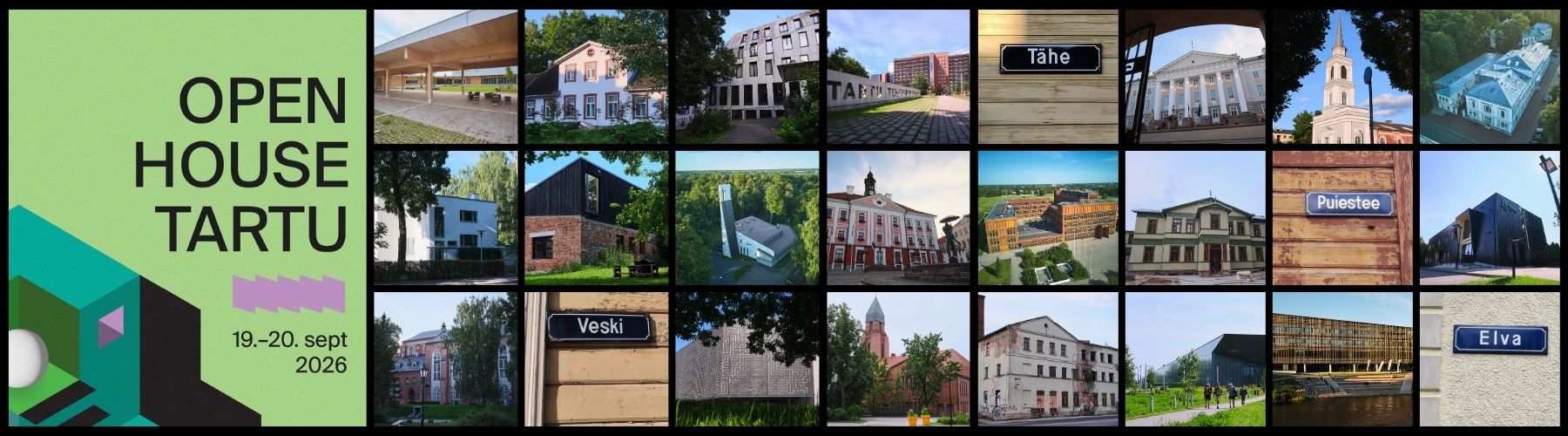
On 19–20 September, the Open House Tartu architecture and urban space festival will introduce residents and visitors to 21 buildings and four streets that stand out for their architecture, history and cultural significance. More than 200 free guided tours will take place over the weekend. In most buildings, one or two tours will also be available in English. The programme includes cultural and heritage buildings, former and current industrial buildings, churches, educational and office buildings, two residential buildings and one hotel.
All guided tours focus on architecture and urban space, and on their links with the people who have lived and still live in Tartu. Visitors will learn when and why a building was designed as it is, what to look for in its architecture, and how the building and its use have changed over time.
Most festival guides are volunteers with an interest in architecture and urban space. Street tours, as well as tours at some institutions, are led by professionals in the field.
Tours take place across Tartu: in the city centre (Tartu Town Hall, the University of Tartu main building, hotel Lydia, St Paul’s Church and the garage house at the Filosoofi str); on and around Toome Hill (University of Tartu Museum at Tartu Cathedral, Tartu Cathedral ruins, the Supreme Court building, St Mary’s Church, St Luke’s Methodist Church, the building at Struve 2 and the Veski Street architecture tour); in Tähtvere (Villa Tammekann); in Tammelinn (the Elva Street architecture tour); in the Maarjamõisa area (University of Tartu’s Physicum building, Tartu Applied Health Sciences University and the National Archives’ Noora building); in Karlova (a street tour); in Ülejõe (the University of Tartu Delta building, the yeast factory quarter, the residential building in the former psychiatric hospital and the Puiestee Street history tour); in the Raadi area (Estonian National Museum); and in Jaamamõisa (RMK Tartu office). Visitors interested in contemporary architecture can also travel just outside Tartu to tour the Raadi kindergarden in Tartu Parish.
With a guide, visitors can take a fresh look at some of Tartu’s oldest buildings, buildings and extensions that have been adapted for new uses, and examples of recent Estonian architecture. The programme includes well-known buildings with spaces that are usually closed to the public. For example, visitors can see the attics of the University of Tartu main building and Tartu Town Hall. Other tours take visitors into buildings and staff areas that are not normally accessible.
At the Estonian National Museum, the Noora building of the National Archives and the University of Tartu Museum, tours are led by members of staff, offering an insight into how these institutions and their buildings work from the inside.
Among the educational buildings are two notable recent buildings next to each other: Tartu Applied Health Sciences University and the University of Tartu Physicum. The programme also includes two prominent university buildings in central Tartu: the University of Tartu main building and the Delta Centre.
On the edge of the city, two examples of contemporary timber architecture are located close to each other. The timber building of Raadi Basic School kindergarden combines learning spaces with outdoor areas designed to support learning. About a ten-minute drive away, the RMK office building stands in the green surroundings of Annelinn and demonstrates different ways of using timber in contemporary architecture.
Four tours focus on sacred architecture. Three take place in churches that are still in active use but differ greatly in character: St Paul’s Church, St Luke’s Methodist Church and St Mary’s Church. The programme also brings back a popular tour of the ruins of Tartu Cathedral, the city’s oldest building. The tour includes medieval passages and a climb to the viewing tower.
The industrial heritage sites in the programme are very different in scale. One tour covers the whole former yeast factory (‘Pärmivabrik’) quarter, which is due to be demolished. At the other end of the scale is a small former garage hidden in a courtyard on Filosoofi Street, now converted into a detached house.
Another example of residential architecture is the former psychiatric hospital at Staadioni 83. Dozens of apartments are now nearing completion in the building, giving new life to Estonia’s largest timber building, where the poet Juhan Liiv was once a patient.
Villa Tammekann in Tähtvere was also originally built as a private house, in 1936. Designed by internationally known Finnish architect Alvar Aalto, it is now in public use.
History and cultural heritage are part of every building tour, but the four street tours created especially for Open House Tartu explore these themes in greater depth. The tours cover Elva, Puiestee and Veski streets, as well as Tähe Street with a focus on Karlova. They are slightly longer than the building tours, take place entirely outdoors and are led by people who work with architecture, urban space or local history professionally.
Based on visitor interest and feedback, eight buildings from the first Open House Tartu festival in 2024 are returning to the programme. Several buildings have received awards or recognition for their architecture or interior architecture, or have been selected by Tartu City Government among the city’s best buildings of the year.
All Open House Tartu guided tours are free of charge.
The street tours and three building tours — the Supreme Court, the Filosoofi Street house and Pärmivabrik — require advance registration. Registration opens on 29 August on this website. You can register on the page of each tour in the Programme section.
If you register for a tour, please make sure you attend. An unused place means that someone else may have missed the chance to join the tour.
We recommend exploring the full programme in advance and planning your own schedule. With so many tours taking place over two days, you will need to decide which ones you most want to see.
The buildings were selected and the tours prepared by curators Mari-Liis Hindre-Merilind, Piibe Piirma and Urmo Mets. The festival producer is Marie Valgre.
Thank you to all our contacts at the participating buildings and to our committed team of volunteers for their close cooperation.
We also thank our supporters: Tartu City Government, Cultural Endowment of Estonia, Kvartal shopping centre, Tartu Centre for Creative Industries, SOHO Hotel and Nudist.
Open House Tartu is a satellite event of Open House Tallinn, and both are part of the Tallinn Architecture Biennale programme. The festival is organised by the Estonian Centre for Architecture.